Fire detection systems installed in open, exposed or temporary environments face a challenge that indoor systems rarely have to deal with: the weather itself. Scaffolding can wrap around a live building for months at a time, cable trays and building envelopes sit fully exposed to the elements, and construction sites are, almost by definition, unprotected. In these settings, a fire detection system has to keep working through blistering summer sun, driving rain, heavy snow and gale-force wind, without losing sensitivity, without degrading, and without triggering false alarms every time the weather changes.
FyreLine EN54 Fixed Linear Heat Detection is designed specifically for this kind of environment. As shown in our latest product film, which follows a single length of FyreLine cable, secured to a scaffolded high-rise, through brilliant sunshine, torrential rain, blizzard snow and a full gale, the system’s cable, fixings and control equipment are built to stay fully functional and completely undisturbed no matter what the weather does. This article looks at the risks and detection challenges that open-air and temporary structures present, how the complete FyreLine EN54 Fixed system — cable, controller and end-of-line device — is engineered to handle them, and the approvals behind it.
Fire Risks in Weather-Exposed and Open-Air Environments
Awareness of fire risk on scaffolded buildings has grown considerably across UK construction, fire engineering and insurance in recent years, particularly on projects involving the removal and replacement of external wall cladding. In the years since the Grenfell Tower fire, the safe management of buildings undergoing recladding works has come under far closer scrutiny, and many such projects have historically relied on costly round-the-clock “waking watch” patrols to cover the fire risk while works are ongoing. It is now increasingly common for a building’s fire risk assessment, or the requirements of its insurer, to call for a fixed, continuously monitored means of fire detection across the scaffold itself for the duration of the project — offering equivalent, or improved, protection without the ongoing cost of a round-the-clock manual patrol. Linear heat detection, running the height and length of the scaffold for as long as the works continue, is increasingly the specified solution.
Beyond that specific driver, open-air and temporary structures present a distinct set of fire risks that permanent, climate-controlled buildings do not. Understanding them is the starting point for specifying the right detection system.
- Open-Air Exposure
- Wind-blown dust and debris, driving rain and constant exposure to sunlight and temperature swings can all affect the performance of detection equipment that was never designed to be used outdoors, increasing the risk of both missed alarms and unwanted false alarms.
- No Fixed Infrastructure
- Scaffolding and temporary structures are, by design, not permanent. There is nothing to drill or bolt into, no first-fix containment, and no permanent power infrastructure — any detection system has to be secured using clips and ties rather than conventional fixings.
- High-Risk Hot Works
- Welding, cutting, grinding and temporary electrical installations are all common on scaffolded buildings and construction sites, and each represents a credible ignition source close to combustible materials.
- Combustible Sheeting and Debris
- Debris netting, shrink-wrap, timber boards and packaging are frequently present on scaffolding and can provide a ready fuel source, while wrapped sheeting can also trap heat against the structure.
- Constantly Changing Layouts
- Scaffolding is erected, altered and struck down as a project progresses. A fire detection system covering it needs to be flexible and re-routable, rather than relying on a fixed network of individually wired point detectors.
Fire Detection Challenges Presented by Extreme Weather
Beyond the fire risks themselves, the weather conditions typical of an open-air installation create specific challenges for the detection technology used to protect it.
- Sun and High UV
- Direct summer sun can raise the surface temperature of dark sheeting and bare steel scaffolding well above the surrounding air temperature. Detection equipment must be able to tell the difference between a hot surface on a sunny afternoon and a genuine, sustained fire condition — and any cable insulation exposed to years of UV needs to resist degradation, embrittlement and cracking over time.
- Rain and Moisture
- Driving rain and standing water threaten cable terminations and electronic enclosures in particular. Moisture ingress at a poorly sealed joint or housing is one of the most common causes of false alarms and intermittent faults in outdoor detection systems.
- Snow and Sub-Zero Cold
- Low temperatures make some cable materials stiffer and more prone to cracking when flexed or clipped into place, and the added weight of accumulated snow can distort or dislodge a poorly specified fixing over time.
- Wind and Storm
- Gale-force wind subjects any external cable run to buffeting and vibration, especially where it runs alongside loosely fixed netting or sheeting that is itself moving violently. Over a long installation, a poorly secured cable can be pulled, chafed or fatigued at its fixing points.
- Rapid Temperature Cycling and Long Runs
- Day-to-night and seasonal temperature swings cycle a cable and its fixings between extremes, while multi-storey scaffolding, roof areas and long building elevations demand continuous coverage across significant distances without any drop in reliability or response time.
FyreLine EN54 Fixed Linear Heat Detection: System Overview
FyreLine EN54 Fixed is a linear heat detection (LHD) system that provides continuous fire detection along the full length of a protected area. Rather than relying on discrete point devices spaced out along a structure, the cable itself is the sensing element — able to detect a rise in temperature at any point along its run and signal the exact location back to the connected controller. This makes it particularly well suited to scaffolding, cable trays, building façades, roofs and other linear structures, which can be protected efficiently without installing large numbers of individual detectors.
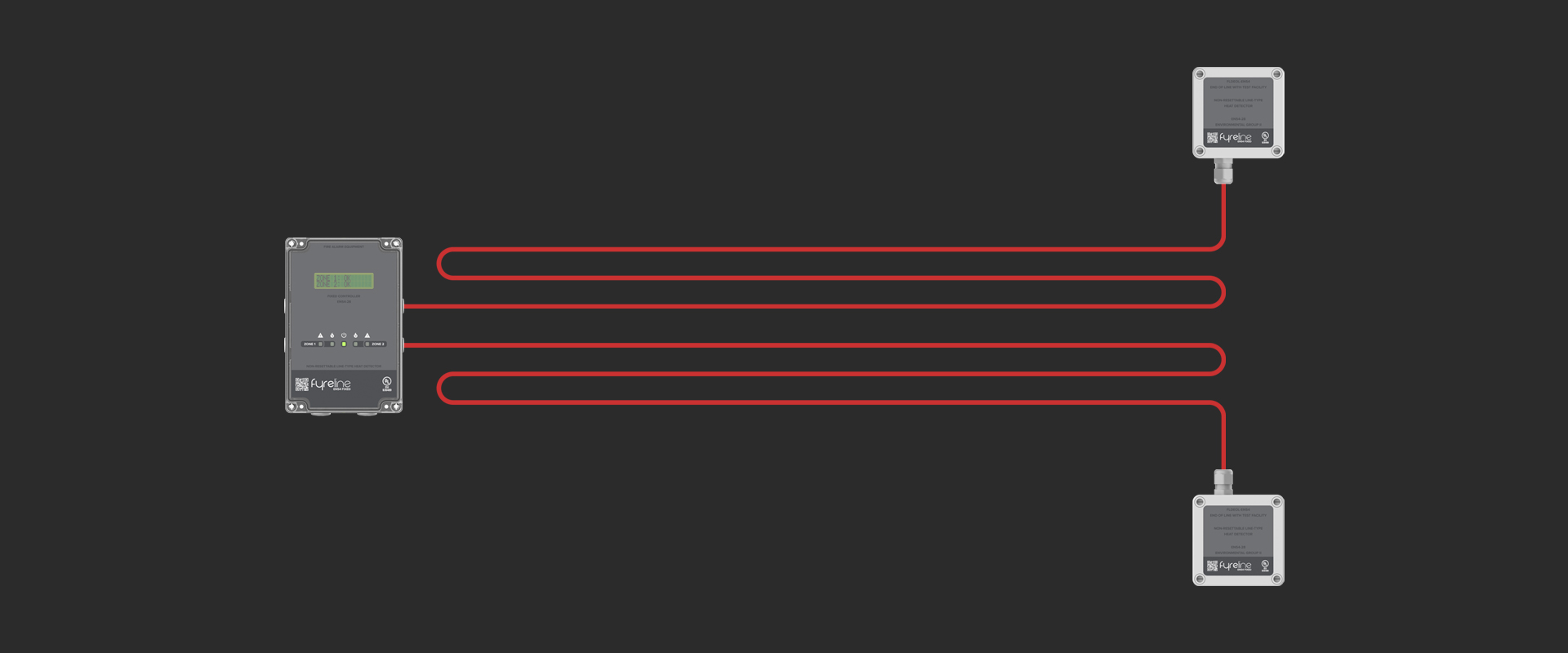
The complete system is approved together to EN54-28:2016 and is made up of three components: the FyreLine EN54 Fixed LHD cable itself, the FyreLine EN54 Fixed Controller (FLDC-EN54 / 18-400), and the FyreLine EN54 Fixed End of Line device (FLDEOL-EN54 / 18-137).
FyreLine EN54 Fixed LHD Cable
The FyreLine EN54 Fixed cable is a non-resettable, line-type heat detector built around a twisted pair of stainless steel cores, held apart by an advanced temperature-sensitive polymer. At a fixed, factory-set temperature, that polymer softens and allows the two cores to touch, triggering an immediate, precisely located alarm. Because the trigger point is fixed rather than relative, the cable is available in three activation temperatures, so installers can match the rating to the ambient conditions of the area being protected:
- 68°C
- Red LSZH sheath, standard ambient applications
- 78°C
- Red LSZH sheath, warmer ambient applications
- 88°C
- White LSZH sheath, high-ambient or high-temperature environments
The outer coating is low smoke, zero halogen (LSZH), UV stable, oil and hydrocarbon resistant, and flame retardant — a specification built for outdoor and industrial exposure rather than sheltered indoor use. An optional stainless steel over-braid adds further mechanical and abrasion resistance for particularly harsh environments.
| Approvals | EN54-28:2016, CE & UKCA Marked, RoHS Compliant |
| Maximum Zone Length | 1,000m (3,280ft) per zone, used with FLDC-EN54 |
| Cable Diameter | 5.72mm standard / 6.30mm with stainless steel braid |
| Minimum Bend Radius | 100mm standard / 125mm with stainless steel braid |
| Ambient Temperature Range | -40°C up to 45°C (68°C/78°C cable) or 65°C (88°C cable) |
| Humidity | 0% to 98% RH |
| Resistance | Approx. 1.25Ω per metre, per core |
| Max Voltage Rating | 49V AC, 74V DC |
FyreLine EN54 Fixed Controller (FLDC-EN54 / 18-400)
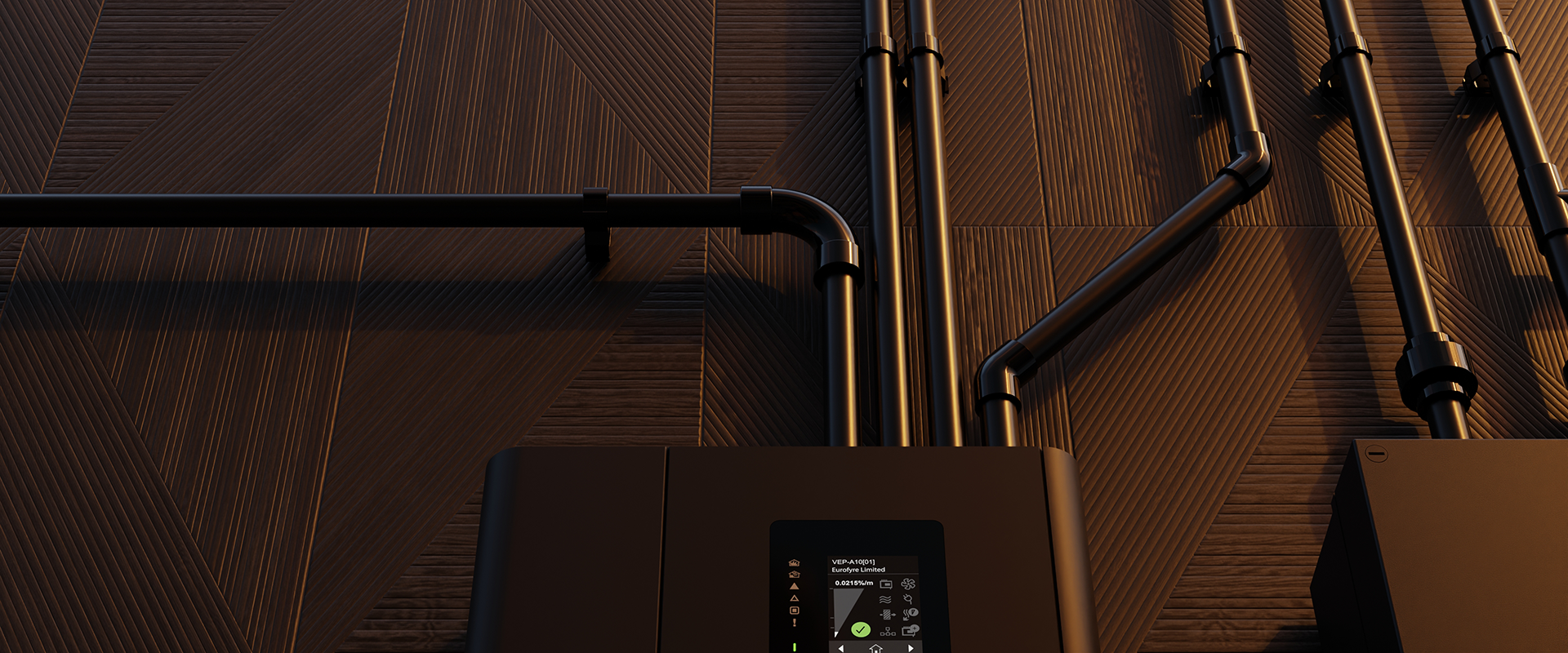
The FLDC-EN54 is a dual-zone module that continuously monitors up to two zones of FyreLine EN54 Fixed cable, each up to 1,000m long, for a fault (open circuit) or an alarm (overheat) condition. If an alarm is triggered, the controller automatically calculates and displays the distance to the alarm point, in metres and feet, on its integrated two-line backlit display — removing the guesswork of physically searching a long cable run to find the affected section.
Each zone can operate independently, or the two zones can be set to interlock, so that an alarm only reaches the fire alarm panel once both zones have triggered — a configuration that further reduces the risk of unwanted alarms in demanding environments. The unit connects to a conventional or addressable fire alarm control panel via separate volt-free alarm and fault relay outputs per zone, and its two-wire RS-485 Modbus RTU/ASCII output allows integration with a wider PLC, SCADA or building management system.
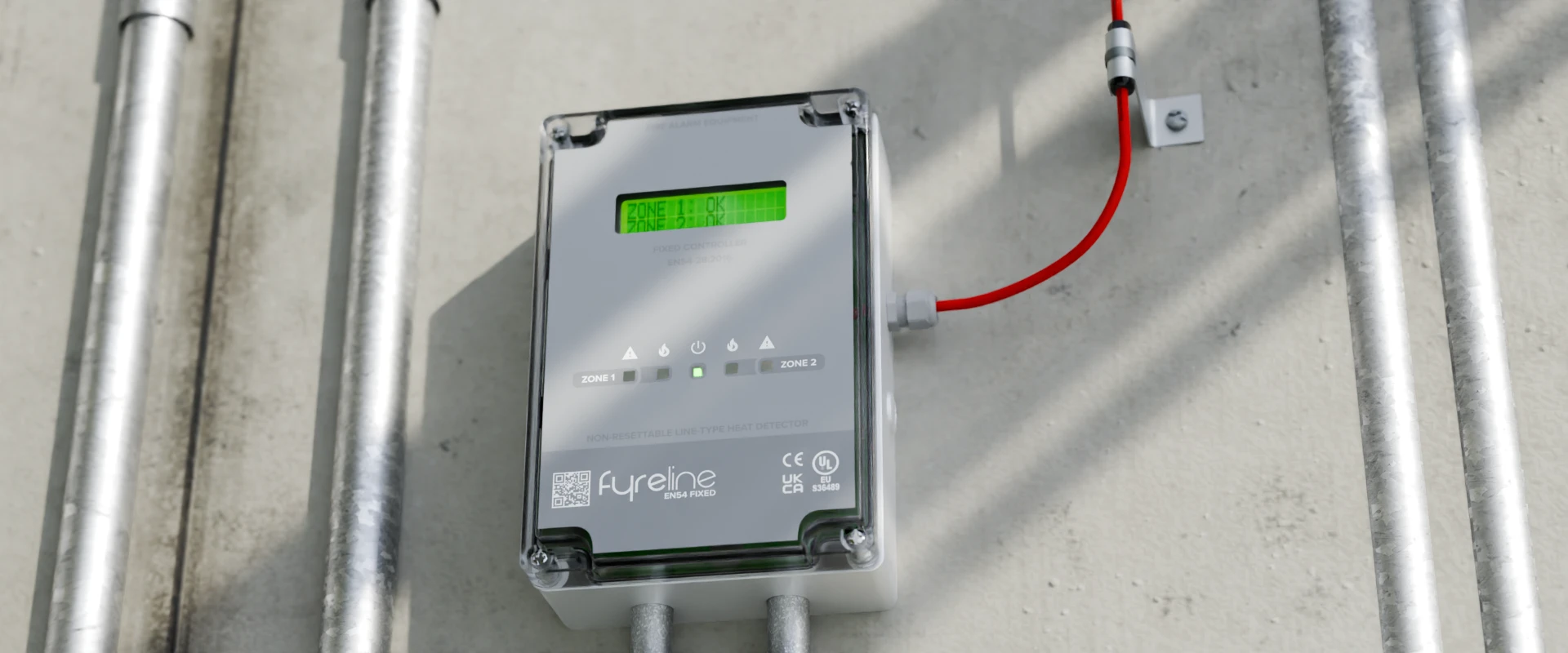
| Approvals | EN54-28:2016, Environmental Group II; UL Listed, File No. S36489 |
| Functional Safety | SIL2 capable per IEC 61508 (low demand mode; random hardware failures and architectural constraints), assessed by ERM |
| Inputs | Up to two Class B zones of FyreLine EN54 Fixed LHD cable |
| Enclosure Rating | NEMA 4, 4X (IP65) |
| Operating Voltage | 12V, 24V or 36V DC |
| Operating Temperature Range | -20°C to +50°C (verified by UL between -10°C and +55°C) |
| Communications | Two-wire RS-485 Modbus RTU/ASCII |
| Alarm Output | 2x Form C volt-free relay contacts, 30V AC/42.4V DC, 2A |
| Fault Output | 2x optoisolated photo-transistor outputs, 35V DC, 80mA |
FyreLine EN54 Fixed End of Line (FLDEOL-EN54 / 18-137)
Fitted at the termination point of each cable run, the FLDEOL-EN54 terminates up to two zones of FyreLine cable inside a secure, weatherproof enclosure and monitors the integrity of the circuit. Built-in switches let engineers simulate an alarm or a fault condition directly at the device, without needing to heat a length of cable, making routine functional testing straightforward even at height or in an awkward location. It is particularly well suited to interlock configurations, where two cables are run side by side.
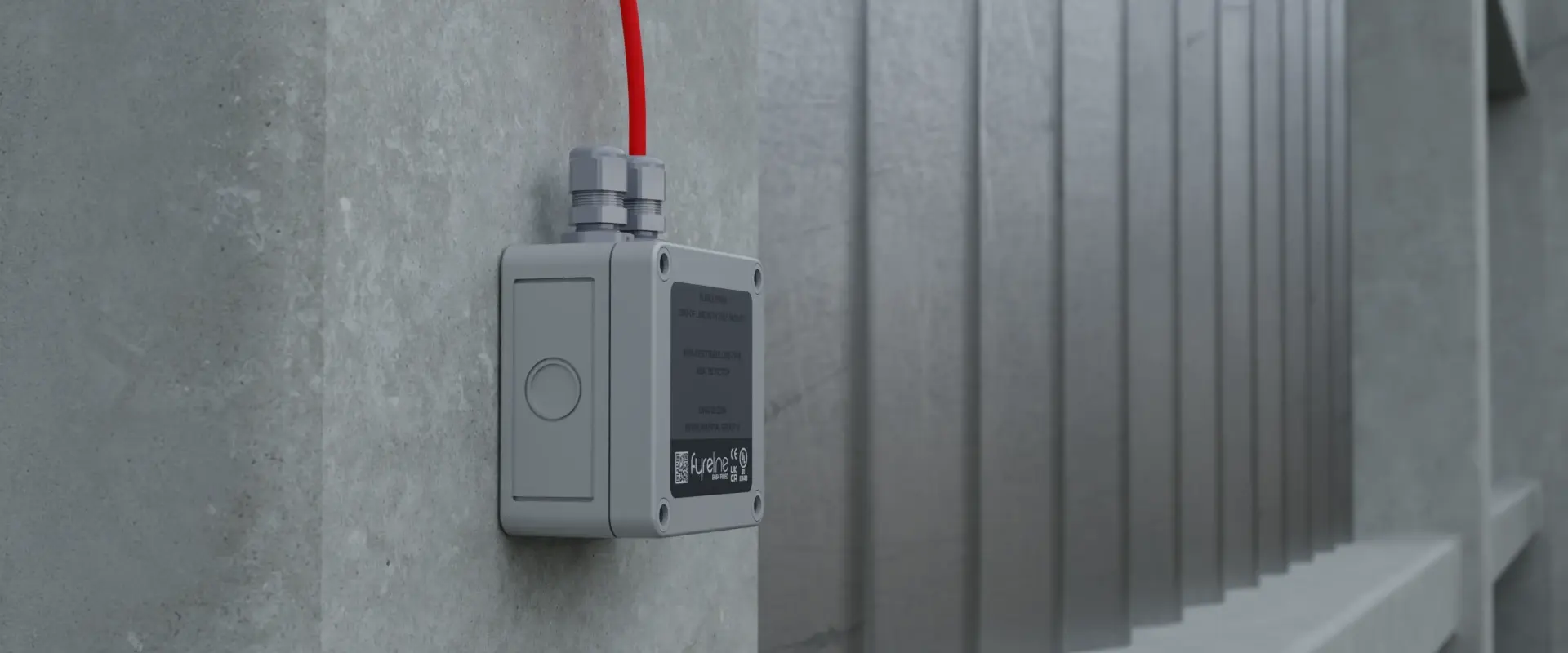
| Approvals | EN54-28:2016, Environmental Group II |
| Enclosure | IP66-rated with 2x IP67-rated cable glands |
| Dimensions (W x H x D) | 94mm x 94mm x 57mm |
| Ambient Temperature Rating | -35°C to +55°C |
How FyreLine EN54 Fixed Stands Up to Sun, Rain, Snow and Storm
The four weather sequences in our product film aren’t just for show — each one maps directly onto a design decision built into the system.
Sun and High UV
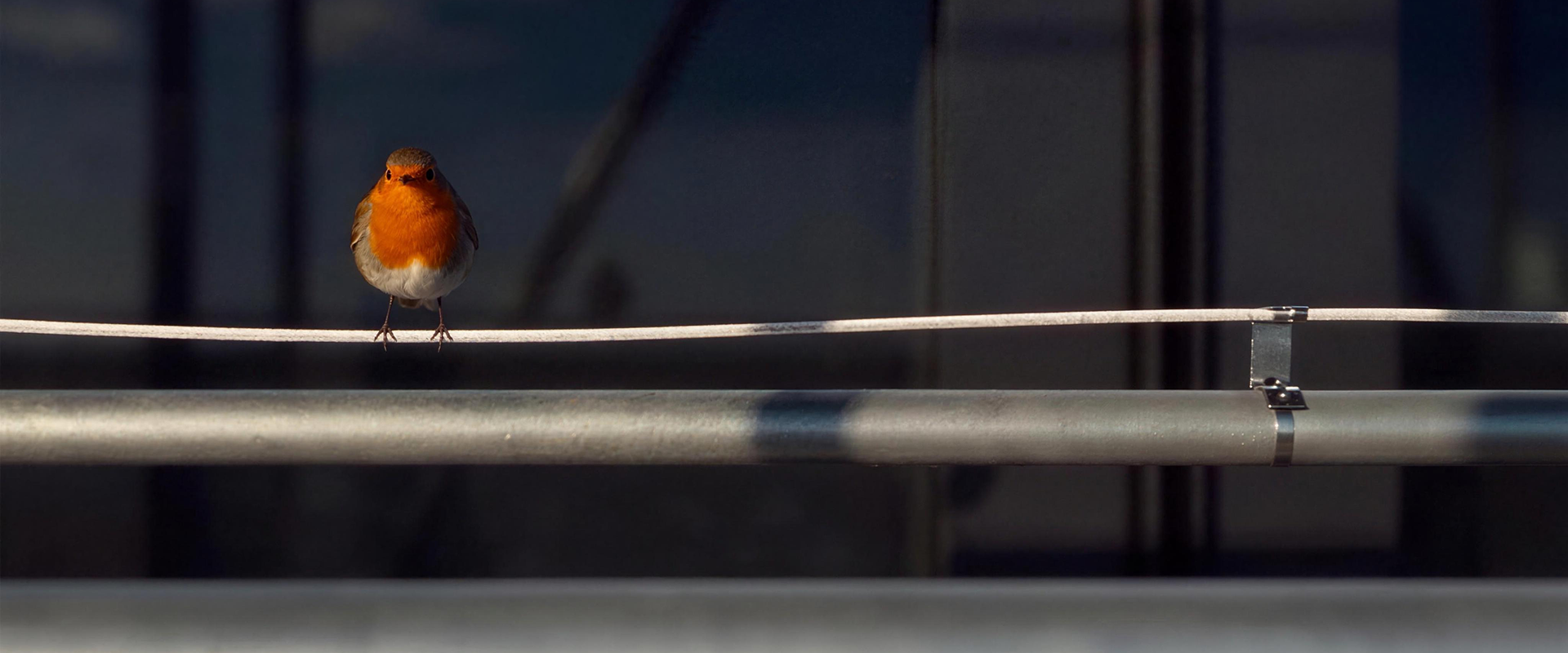
The cable’s UV-stable LSZH outer coating is formulated to resist the embrittlement and cracking that ordinary cable jacketing suffers under prolonged sun exposure, so its protective properties don’t fade over years of installation. Because activation depends on a fixed, sustained temperature rather than a relative change, a sun-warmed scaffold tube or a hot afternoon on site won’t, on its own, bring the cable anywhere near its rated activation point.
Rain
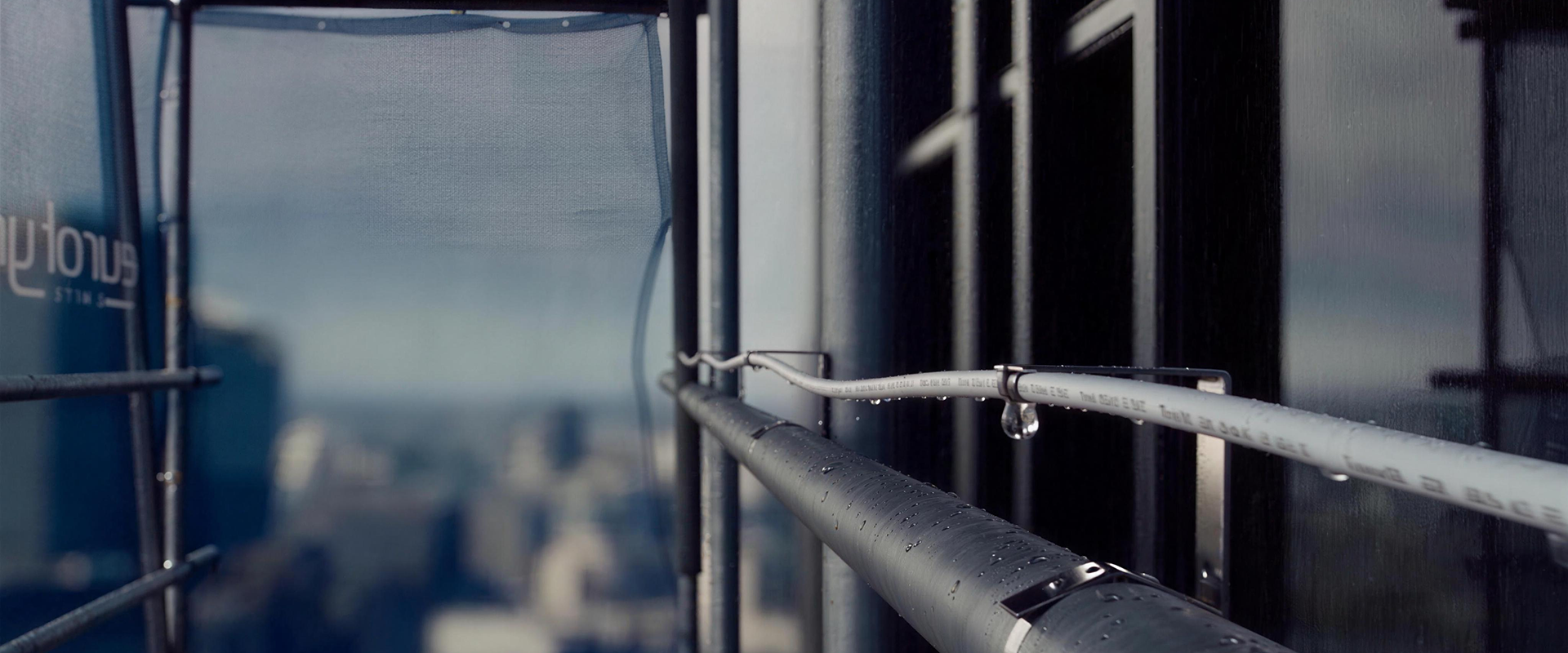
The twisted core pair runs the full length of the cable inside a single, continuous, moisture-resistant sheath, so there is no seam or joint along its run for water to exploit. The only points that need a weatherproof seal — the controller, junction boxes and the end-of-line device — are rated IP65 or better, with IP67-rated cable glands forming a secure, moisture-proof entry for the cable itself.
Snow and Sub-Zero Cold
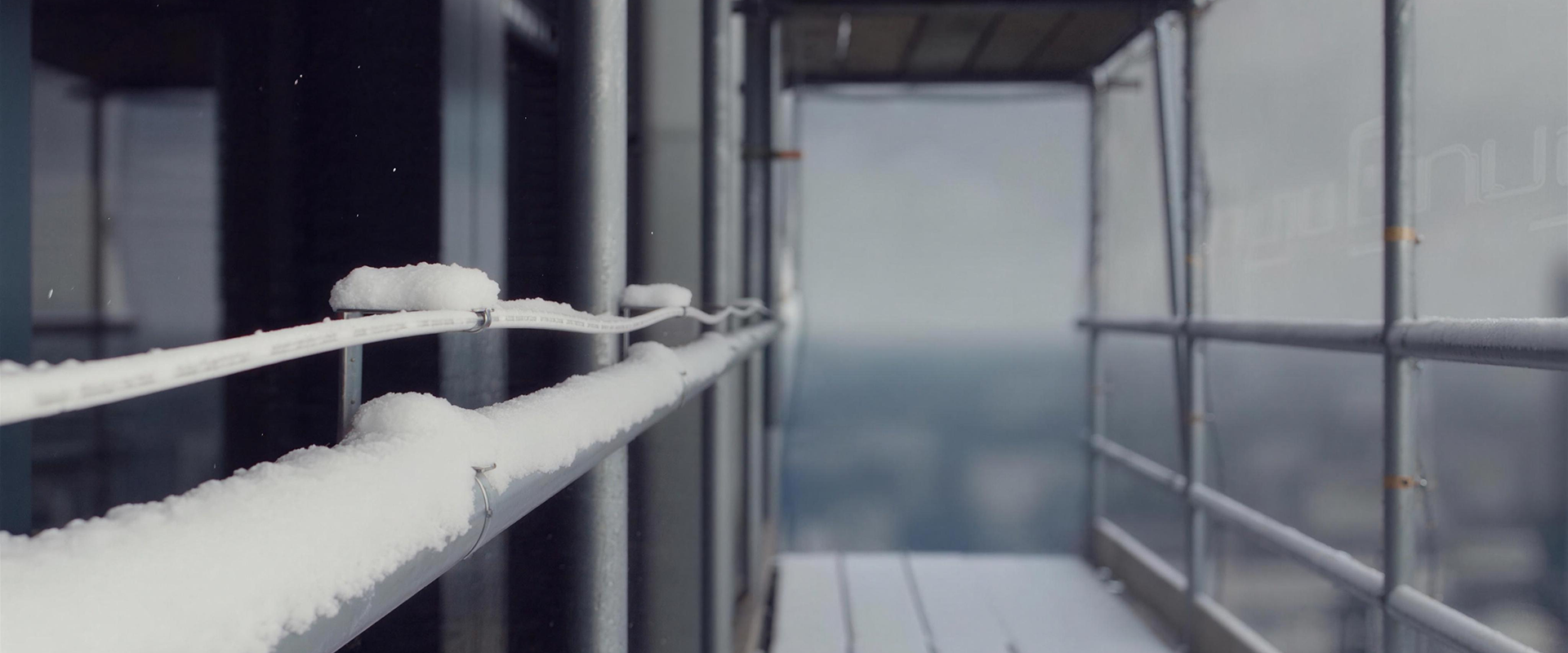
The standard cable is rated down to -40°C ambient, well beyond what most UK sites will ever experience, and the black silicone sleeve fitted at every fixing point isolates the cable from the heat-sink effect of a cold metal bracket. Eurofyre’s installation guidance also builds in extra margin for genuinely low-temperature sites: increasing the minimum bend radius, tightening support spacing and allowing for the small amount of linear shrinkage the cable can undergo at extreme cold.
Wind and Storm
Every metre of cable is held in place by a stainless steel bracket and a black silicone sleeve, secured with two separate stainless steel cable ties — one holding the sleeved cable to the bracket, the other holding the bracket to the structure. Because nothing is drilled or bolted, the fixing flexes with the structure rather than fighting it, while remaining completely static regardless of how violently surrounding sheeting or netting is moving in the wind. Where mechanical exposure is severe, the optional stainless steel over-braid adds a further layer of abrasion resistance.
Approvals
FyreLine EN54 Fixed Linear Heat Detection — cable, controller and end-of-line device together — has been independently tested and approved to give specifiers and installers confidence wherever it’s used:
- EN54-28:2016 — Fire detection and fire alarm systems, Part 28: Non-resettable line-type heat detectors
- CE and UKCA marked
- RoHS compliant
- UL Listed (File No. S36489)
The FyreLine EN54 Fixed Controller (FLDC-EN54) has also been independently assessed as SIL 2 capable under IEC 61508, covering random hardware failures and architectural constraints in a low demand mode safety function — useful confirmation for specifiers incorporating the system into a wider Safety Instrumented Function.
Installation should always be carried out by a qualified, trained professional in accordance with BS 5839-1:2017 (or the relevant country equivalent), IEC 60364, and the requirements of the local authority having jurisdiction.

Design and Installation Considerations
Controller and End of Line Placement
Both the FLDC-EN54 and FLDEOL-EN54 are weatherproof, but locating them somewhere accessible — a site cabin, plant room or similarly sheltered spot — makes routine testing and maintenance far more straightforward for engineers, without needing access to the scaffold or roof itself.
Cable Routing
FyreLine cable should be run as one continuous length wherever possible, rather than cutting back and forth, and avoiding any ‘T’ connections or spurs — the cable is a series circuit, not a branching network. Beyond that, the exact route and coverage for a given scaffold or structure should always be determined by a project-specific fire risk assessment, carried out by a competent person, taking into account the layout, materials, activities and specific risks of that site. Our product film shows one example configuration rather than a fixed installation instruction.
Published guidance such as BS 5839-1 (Section 22.6) can help inform that assessment — for example, it suggests that at a typical 7.5m ceiling height, runs should be no more than 10.6m apart, kept at least 0.5m clear of any wall or obstruction, with no protected point more than 5.3m from the nearest section of cable. On a temporary structure like scaffolding, however, the findings of the fire risk assessment for that specific project should always take precedence over generic, evenly spaced coverage.
Mounting Hardware
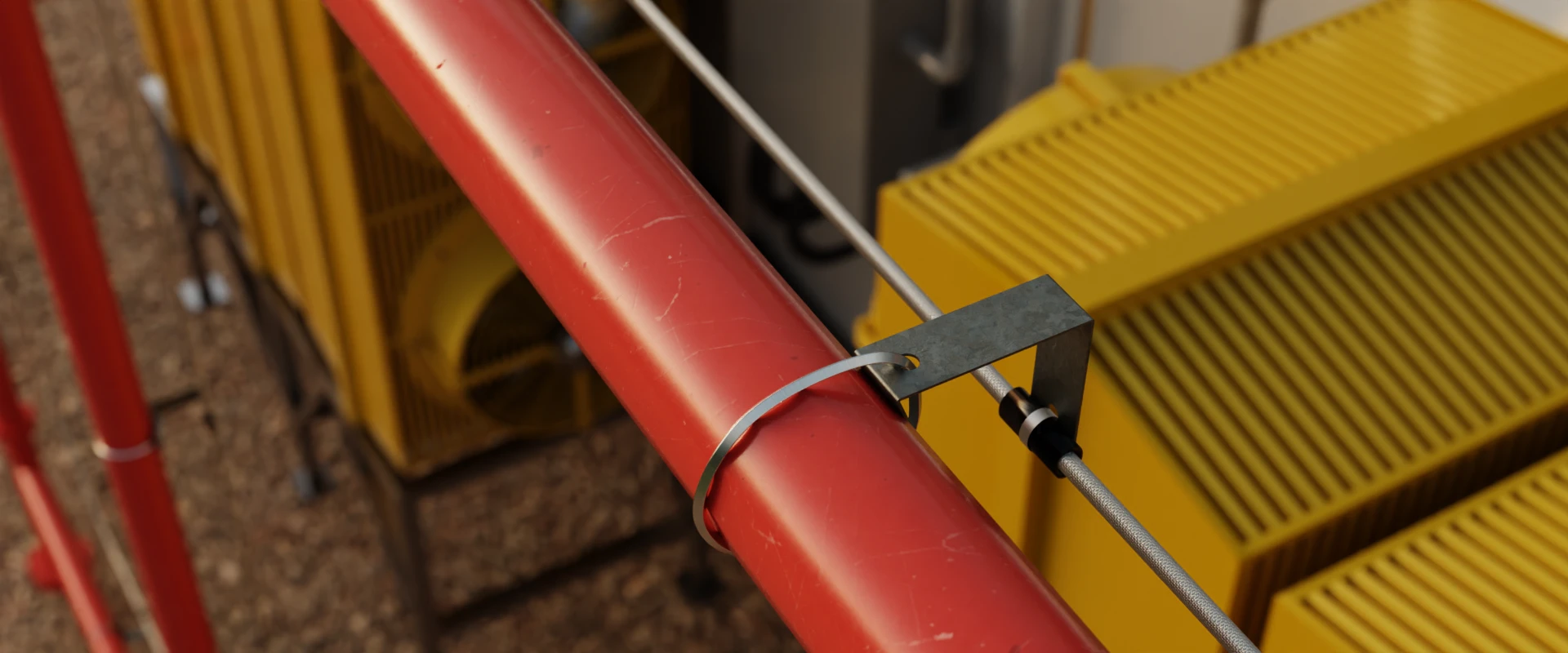
A black silicone sleeve always sits between the cable and its fixing point, isolating it from the heat-sink effect of bare metal. On scaffolding, FyreLine’s pipe bracket is purpose-designed for this fixing: its underside is formed into a V-shape that cradles the scaffold pole directly, and the bracket is secured around the pole with a stainless steel cable tie, while a second stainless steel cable tie holds the sleeved cable to the bracket’s flange above — the same fixing method shown throughout our product film. On other structures, the same principle applies using an equivalent bracket suited to the surface being clamped to.
Brackets are typically spaced at around 1m centres along a run, and supports more generally should sit no more than 0.6m to 1.5m apart. As with cable routing, exact bracket positioning along a given structure should follow the findings of that project’s fire risk assessment rather than even spacing alone. The cable should never be bent tighter than its minimum bend radius or placed under excessive tension.
Low-Temperature Installations
For cold storage, exposed roofs or winter installations, Eurofyre recommends avoiding installation below -10°C ambient where possible, increasing the minimum bend radius to 150mm, tightening support spacing, and allowing for up to 1–2% linear shrinkage of the cable at -40°C.
Splicing and Repair
Because the cable is non-resettable, any section that has activated — or been physically damaged — must be cut out and replaced, along with at least 3m either side of the affected point. Splices should always be made in a weatherproof junction box using secure terminal blocks; the cable’s two cores must never be soldered together directly.
Why Choose Eurofyre?
- Complete System Supplier
- Eurofyre supplies every part of the FyreLine EN54 Fixed system — cable, controller, end-of-line device and mounting hardware — as one fully approved package, backed by expert advice and consultation from a single point of contact.
- Demonstration and Training
- We offer demonstrations and expert training across the FyreLine range, including FyreLine EN54 Fixed and FyreLine Resettable linear heat detection, at our own dedicated training facility.
- After-Sales Support
- Eurofyre offers telephone support to help ensure your system stays fully functional and operating at maximum efficiency, backed by after-sales care that is second to none.
Frequently Asked Questions
What is linear heat detection?
Linear heat detection (LHD) is a fire detection method that uses a continuous sensing cable, rather than individual point detectors, to detect a rise in temperature at any point along its length. It’s particularly effective for protecting long, linear structures such as scaffolding, cable trays, tunnels and building façades.
What temperature does FyreLine EN54 Fixed cable activate at?
FyreLine EN54 Fixed cable is available in three fixed activation temperatures — 68°C, 78°C and 88°C — so the rating can be matched to the normal ambient temperature of the area being protected.
Is FyreLine EN54 Fixed cable suitable for outdoor use?
Yes. The cable’s LSZH outer coating is UV stable, oil and hydrocarbon resistant, and flame retardant, and the cable is rated for ambient temperatures from -40°C up to 45°C or 65°C depending on the variant, making it suitable for scaffolding, building envelopes and other open-air or temporary structures.
Is FyreLine EN54 Fixed cable resettable after an alarm?
No. It is a non-resettable, line-type heat detector — once a section has activated, that section (plus at least 3m either side) must be cut out and replaced with a new spliced section.
How is FyreLine EN54 Fixed cable fixed to scaffolding?
The cable is secured using a pipe bracket whose V-shaped underside cradles the scaffold pole directly, held in place with a stainless steel cable tie, while a second stainless steel cable tie holds the sleeved cable to the bracket. The exact route, coverage and spacing for a given structure should always be determined by a project-specific fire risk assessment carried out by a competent person, rather than a fixed specification.
Is the FyreLine EN54 Fixed Controller SIL rated?
Yes. The FLDC-EN54 has been independently assessed as SIL 2 capable under IEC 61508, covering random hardware failures and architectural constraints for use in a low demand mode safety function, in addition to its EN54-28:2016 approval.
Why is linear heat detection increasingly specified on scaffolding during cladding replacement projects?
Following increased scrutiny of fire safety on buildings undergoing external wall or cladding remediation, many insurers and fire risk assessments now call for a fixed, continuously monitored means of fire detection across the scaffold for the duration of the project, in place of, or alongside, manual fire-watch patrols. Linear heat detection cable, running the height and length of the scaffold, meets this requirement while offering continuous coverage without the ongoing cost of round-the-clock patrols.
Get in Touch
For more information about FyreLine EN54 Fixed Linear Heat Detection, or to discuss any of the other products Eurofyre has to offer, get in touch by phone on +44 (0) 1329 835 024, by email to [email protected], or via the online enquiry form on our contact page.
Don’t forget you can follow us on LinkedIn and Instagram, or sign up to our newsletter to receive all the latest information from Eurofyre.