Using Wi-Fyre with an existing conventional fire alarm system

2 mins read

The conventional fire alarm system is most commonly used in small properties where detailed information on device locations is not normally required and where zones are used for identification.

The biggest disadvantage with conventional fire alarm systems is that detectors and alarm devices cannot be combined on the same circuit. Detectors, sounders and other alarm devices are all wired on separate radial circuits meaning that, compared to an addressable system, more cabling is required and installation time is drastically increased.

Why Wi-Fyre is extremely useful for inclusion with an existing conventional fire alarm system

Lets assume that a new owner has taken control of a small commercial property and would like to upgrade the existing conventional fire alarm system. The new owner does not want to disrupt the building fabric with the installation of unsightly cables and does not want to affect the operation of the building while the upgraded system is installed.

These requirements can be easily met by using Wi-Fyre. As long as the installer has access to the zone and alarm circuit cabling, at any location on the existing cabling route, a Wi-Fyre transponder can be fitted without causing any disruption to the property. Wireless devices can then be added to the zone provided that the signal strength is acceptable.
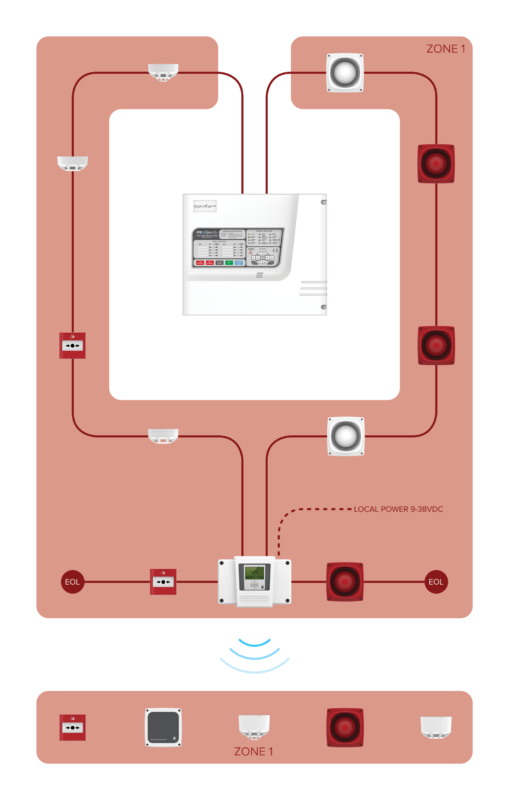
The advantages of using Wi-Fyre over hard-wired device additions are:

  • No disruption to building fabric
  • Minimal disruption to occupants
  • Fast installation time (usually the same day)
  • Minimal additional wiring (may require a 24V power source)
  • Simple configuration

If you have any questions about Wi-Fyre or any of its available components please feel free to get in touch either by email to [email protected], by telephone on +44 (0)1329 835024 or by filling out our online contact form.
    Contact Eurofyre

    30th September 2026

    SecuriSmoke ASD 2000 for Hospitals

    Hospitals are among the most complex buildings in the built environment, combining wards, operating theatres, diagnostic imaging suites, laboratories, plant rooms, pharmacies and administrative offices within a single site that typically operates around the clock. They accommodate patients with varying levels of mobility, alongside clinical staff, visitors and contractors, often across multiple interconnected buildings of […]

    Read Article
    Oggioni DUST Gas Detection in Petrolchemical Plants

    23rd September 2026

    Oggioni DUST Gas Detection in Petrochemical Plants

    Petrochemical plants process, refine and store large volumes of hydrocarbons and other chemical feedstocks, converting raw materials into fuels, plastics, solvents and a wide range of industrial products. These sites typically combine process units, storage tanks, pipelines, loading facilities and control buildings across extensive, often continuously operating, industrial complexes. Given the volume and nature of […]

    Read Article

    17th September 2026

    FyreLine EN54 Fixed Linear Heat Detection: Unaffected by the Weather

    Fire detection systems installed in open, exposed or temporary environments face a challenge that indoor systems rarely have to deal with: the weather itself. Scaffolding can wrap around a live building for months at a time, cable trays and building envelopes sit fully exposed to the elements, and construction sites are, almost by definition, unprotected. […]

    Read Article
    • FyreLine Linear Heat detection
    • Crisis Emergency Voice Communication
    • Xenos Wireless Fire Detection

    Eurofyre is proud to supply its own brands to the fire detection and safety market. All of our products are high quality, extremely reliable and cost-effective.

    Sales & Technical Support

    Eurofyre Sales and Technical Support

    Accreditations

    ISO 9001
    UKAS Management System
    Fire Industry Association
    British Chamber of Commerce