Coincidence Detection
The principle behind coincidence?
Commonly known as “double knock”. Coincidence detection relies on alarm signals across two zones or between two detectors to activate before any evacuation/alarm occurs. In this instance, depending on the ASD specification, a detector or each pipe inlet can be used as a zone/address. Look at the table below to see which detectors can be used as a single zone or multiple zones/address.
Why coincidence detection?
Coincidence detection is often used for verification. This approach is generally used in conjunction with automatic suppression and sprinkler systems to avoid unwanted discharge which is expensive and leaves the application vulnerable until restoration of the fire detection system. It is also used in areas where unwanted alarms have unacceptable consequences.
ASD technology being used for coincidence:
Aspirating smoke detection systems can be used for coincidence detection. ASD systems have many advantages over standard point detection systems such as being high sensitivity and having the ability to configure pre alarm and alarm thresholds, meaning a coincidence (double knock) can be detected at any class sensitivity – A, B or C.
Redundancy Detection
What is detector redundancy?
It is a technique which uses two or more detectors to guarantee continuous protection if one detector malfunctions or is removed.
What are the benefits in using an ASD over a point detector for redundancy detection? In some cases, such as the requirements for smoke detection in areas where high value items are located, Class A sensitivity is the preferred choice. ASD’s are far more sensitive to the standard point detector. They can indicate smoke at a very early stage allowing for faster responses times.
The table below displays examples of coincidence and redundancy arrangements:
| Description | Arrangement | Compatible ASD | Advantages | Disadvantages | Example |
| Two independant aspirating smoke detection systems protecting the same area using separate pipework. | 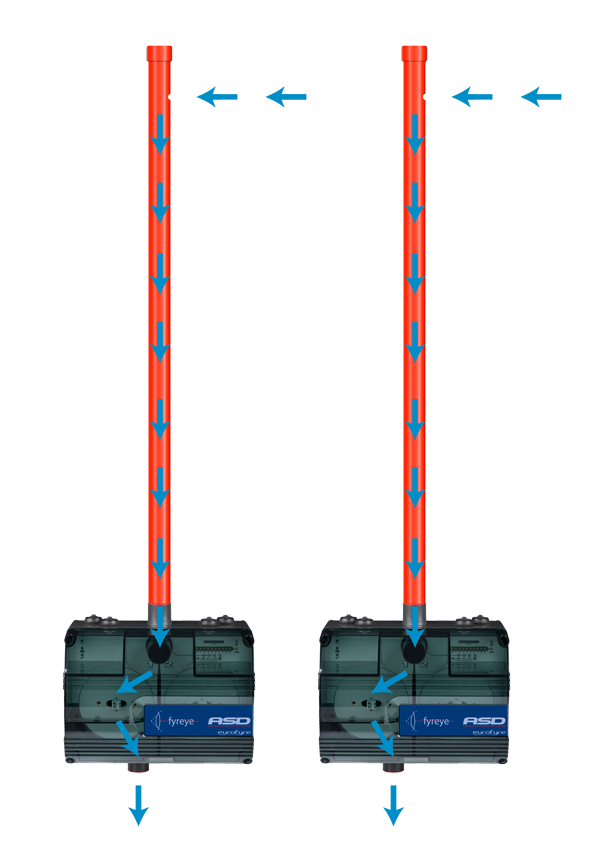 Example – EF-ASD1, 50m max per pipe with single 8mm hole @ Class C | EF-ASD1 Xtralis XCC EF-LASD1 EF-FTP | Continuous protection if one system fails or is removed (redundancy detection) Coincidence detection between the two independant aspirating smoke detection systems. | Duplication of equipment doubles the cost of the supply and installation. |
|
| A single aspirating smoke detector with two individual detectors sharing the same pipe network protecting one area. | 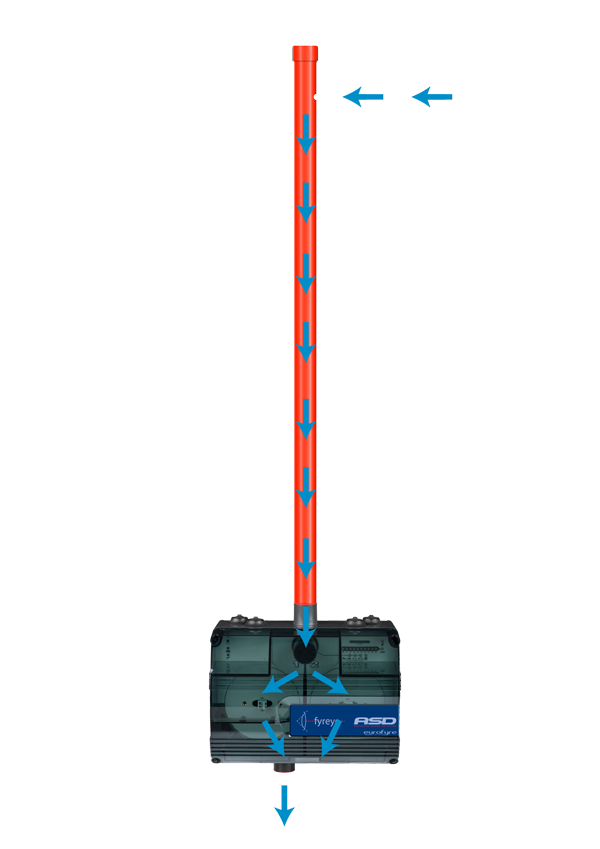 Example – EF-ASD1, 50m max per pipe with single 8mm hole @ Class C Example – EF-ASD1, 50m max per pipe with single 8mm hole @ Class C | EF-ASD1 | Detectors are duplicated for redundancy and coincidence. | Shared pipe network and aspirating fan. |
|
| A single aspirating smoke detector with two detectors which protects the risk with separate pipe networks. | 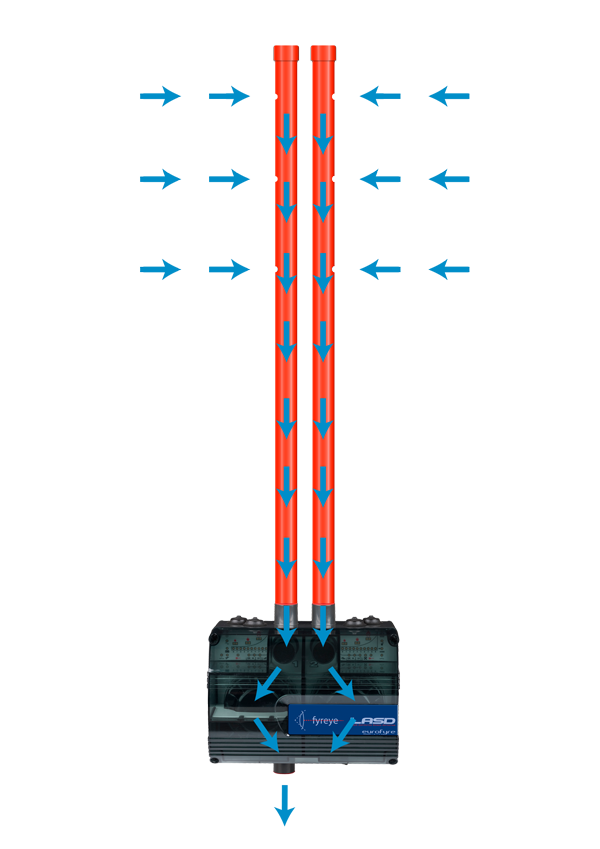 Example – EF-LASD2, 100m max per pipe with 3 holes @ Class A Example – EF-LASD2, 100m max per pipe with 3 holes @ Class A | EF-ASD2 EF-LASD2 | Coincidence from independent sampling pipe networks and detector devices. | Shared aspirating fan. |
|
| A single aspirating smoke detector with individual addressable pipe networks protecting the risks. | 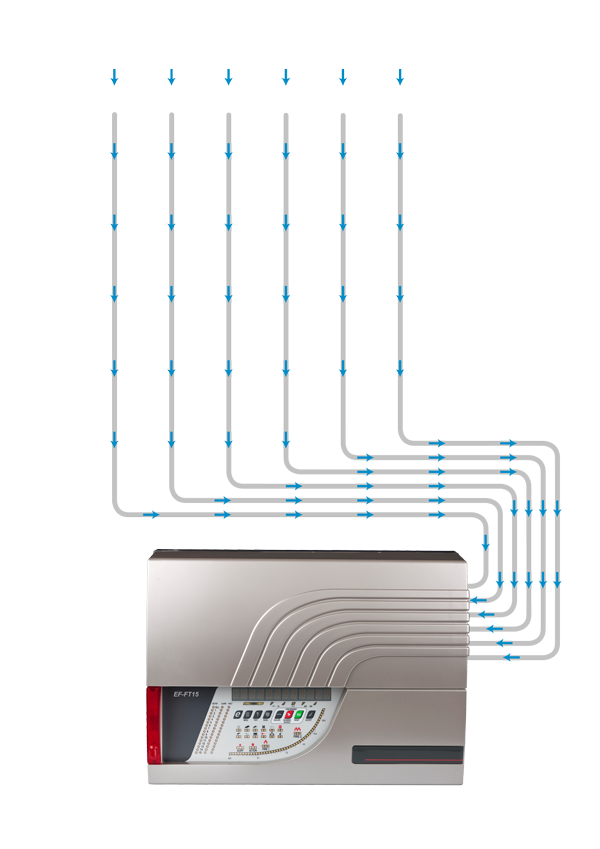 Example – EF-FT15, 6 of 50m microbore pipes @ Class A. EF-FT15 can have a maximum of 15 pipes per system. Example – EF-FT15, 6 of 50m microbore pipes @ Class A. EF-FT15 can have a maximum of 15 pipes per system. | EF-FT4 EF-FT6 EF-FT15 | Coincidence from independent sampling pipe networks and detector devices. | Shared aspirating fan. |
|
For more information on aspirating smoke detection systems click here, alternatively, please do not hesitate to get in touch either by email to [email protected], by telephone on 01329 835 024 or through our online enquiry form